Digit-style practice: solve numerical reasoning blanks
Written and maintained by CKAutoFlow
If you are looking for P&G Digit Challenge practice, start by learning how equation blanks and distinct-digit constraints work. This guide uses original examples to explain remainders, divisibility and parity. These methods narrow the search; we do not claim a measured speed improvement or reproduce every official numerical task.
The method at a glance
Turn equation blanks into constraints using the order of operations, then eliminate candidate digits with parity, divisibility and remainders. Every candidate must satisfy the target value, permitted digit range and distinct-digit requirement. Finding one valid assignment does not establish that it is unique.
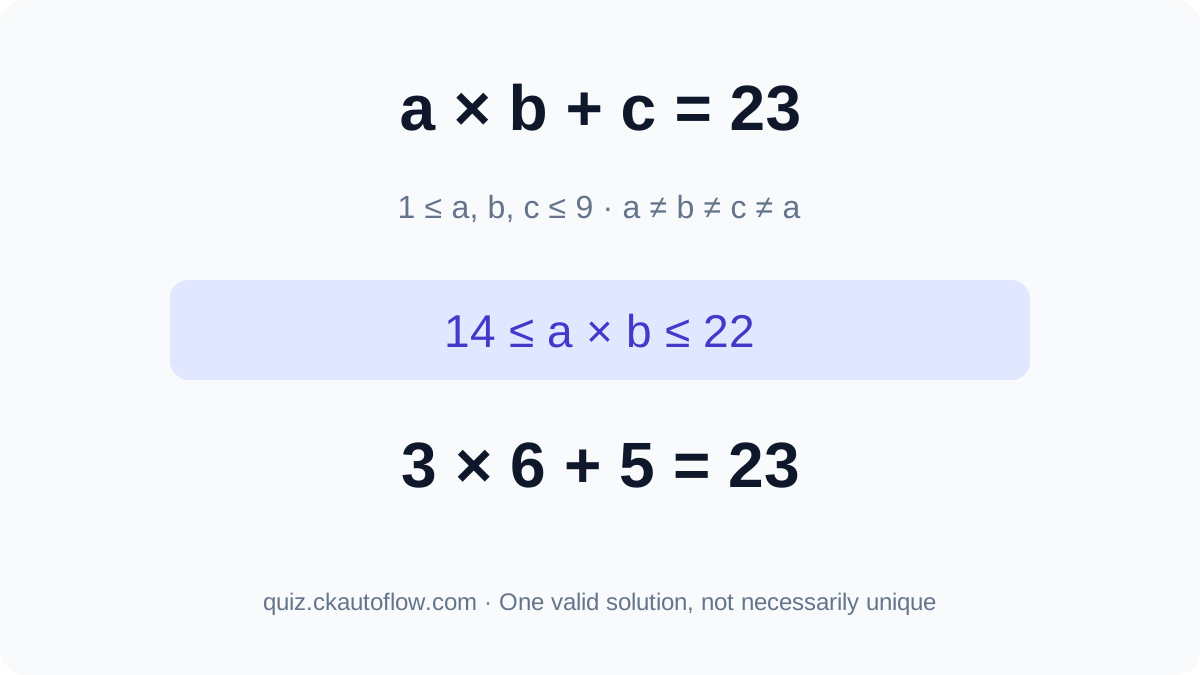
1. Why brute force does not work
Three blanks with digits from 1 to 9 give 729 combinations, and even requiring them to be distinct leaves 504. At one second each that is far beyond the time budget for a single question. The real method is not to calculate faster, but to prove that almost every combination is impossible and then check only the handful that survive.
2. Three tools for cutting the space
Handle the multiplication first
In an equation mixing addition and multiplication, the product sets the magnitude and the addition only nudges it. For a x b + c = target, c is at most 9, so the product must fall between target minus 9 and target minus 1. That single observation usually takes the candidates from hundreds down to a handful.
Worked example: a x b + c = 47, digits from 1 to 9, all distinct
- Step 1: c ranges from 1 to 9, so a x b must lie between 38 and 46.
- Step 2: list products of two distinct digits from 1 to 9 in that range. Only 5x8=40, 6x7=42 and 5x9=45 qualify.
- Step 3: recover c for each. Product 40 gives c = 7, and 7 is not used by 5 or 8, so it works. Product 42 gives c = 5, which works. Product 45 gives c = 2, which works.
- Step 4: check distinctness. The triples (5,8,7), (6,7,5) and (5,9,2) all pass.
- Result: three solutions, found with three divisions and three subtractions instead of testing 504 combinations.
Parity
Parity is the cheapest elimination available and you can apply it at a glance. A product is even if either factor is even, and odd only when both factors are odd. A sum is even when both terms share parity and odd when they do not. Applying this against the target typically removes half the remaining candidates at once.
- Odd target with a x b + c: if the product is even, c must be odd; if the product is odd, meaning both a and b are odd, then c must be even.
- Even target: the product and c must share parity.
- Subtraction behaves identically. Parity depends only on whether the two terms match, not on the sign.
Divisibility and remainders
When the equation contains a division, or the target is a multiple of 3, 5 or 9, divisibility can pin a digit outright. The useful tool is the digit sum: a number is divisible by 9 exactly when its digits sum to a multiple of 9, and the same logic applies for 3. With division in the equation, the numerator must be divisible by the denominator or that branch is dead immediately.
3. The standard procedure
- Read the constraints. Is the range 1 to 9 or 0 to 9, and must the digits be distinct? These two decide the size of the search space, and misreading either wastes the whole question.
- Find the term with the largest magnitude, usually a product or quotient, and use the target to bound its possible range.
- List the factor combinations that fall inside that range. There are usually fewer than five.
- Apply parity and divisibility to discard the obviously impossible ones.
- For each survivor, recover the remaining blanks and check the distinctness constraint.
- Substitute the complete solution back into the original equation and verify.
The distinctness constraint is easy to overlook, but it is also the best filter you have. Apply it before the final step rather than discovering a clash after finishing the arithmetic.
4. Where marks are lost
- Ignoring operator precedence. Multiplication and division come before addition and subtraction, and brackets come first. Reading 2 + 3 x 4 as 20 is the classic slip.
- Reading the range as 0 to 9 but working as though it were 1 to 9, or the reverse. When 0 is allowed, a product can collapse to zero, which opens up a whole extra family of solutions.
- Missing the distinctness requirement and submitting an answer with a repeated digit.
- Reversing the operands in a subtraction or division.
- Stopping at the first solution. Many questions have several, and if two options both fit you have missed a constraint.
5. How to practise
The bottleneck is rarely arithmetic ability; it is whether reducing before calculating has become a habit. Use the solver to see every solution to the same question, because seeing how solutions cluster builds intuition about which combinations are worth trying. Then work through timed questions in the practice bank, forcing yourself to write down the feasible product range before doing any arithmetic.
Put the method into practice
After the 24-hour full-feature trial, get 10 random new questions per practice type (10 lifetime memory rounds) and use each solver 10 times for free, with no daily reset. Paid access unlocks new generated questions and continued solving with 7-day access.
Sources and updates
Hiring-process information refers to P&G Careers. Mathematical examples and solving explanations are written for this site. The employer’s invitation and official information determine the actual assessment requirements. Article dates change when the content is substantively revised.