P&G Switch Challenge preparation with pipeline practice
Written and maintained by CKAutoFlow
If you are looking for P&G Switch Challenge practice, pipeline logic exercises can help you learn position reordering. These original questions do not reproduce an official assessment. Four shapes enter a pipeline, pass through a row of boxes, and leave in a different order. Each box applies one fixed reordering rule, and the question usually hides a box and asks what it must have done. This guide covers the structure underneath the pictures, two reliable solving methods, and what to do when more than one box is unknown.
The method at a glance
A pipeline box reorders positions. Work forward from the input to the unknown box and backward from the output to its other side. Match each output shape to its input position to recover the missing rule, then verify it through the complete pipeline.
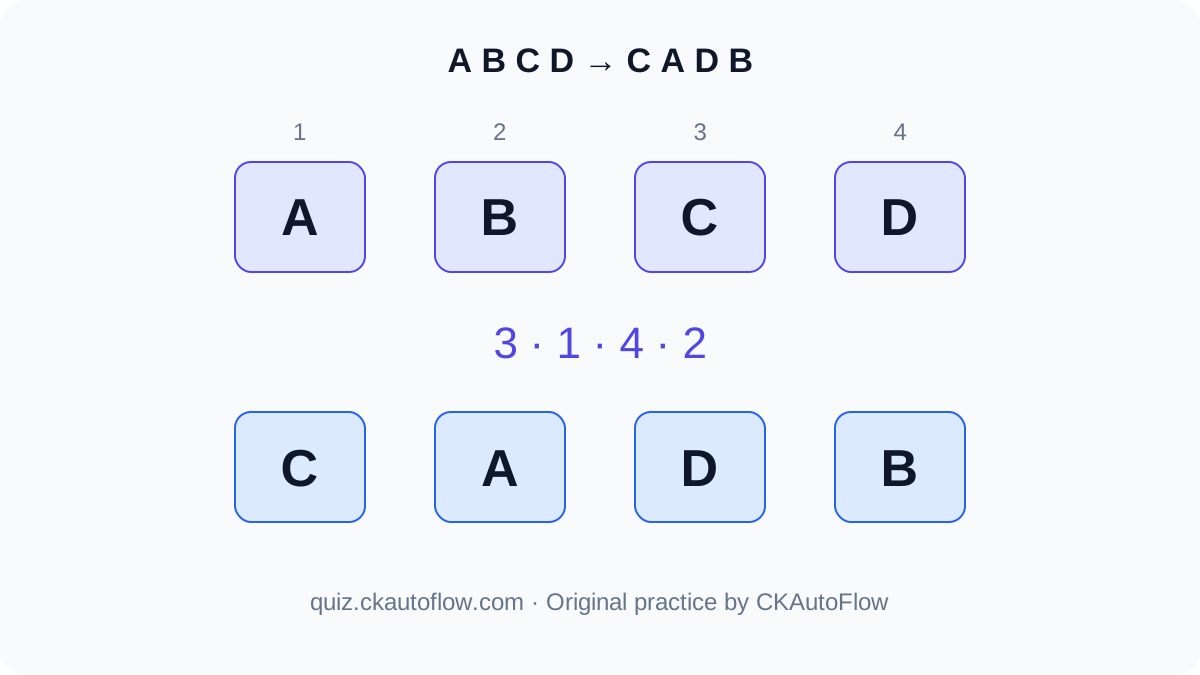
1. What the question actually tests
Strip away the shapes and a pipeline question is composition and inversion of permutations. The order of four shapes is a permutation of 1 to 4, each box is a permutation acting on positions, and sending shapes through the boxes composes those permutations in sequence. Once you see it that way, the question stops being a visual puzzle and becomes arithmetic you can execute mechanically.
- Input row: the order the shapes enter in.
- Box: one reordering rule written as four digits. 3142 means the new first position takes whatever was in the old third position, the new second takes the old first, and so on.
- Output row: the order the shapes leave in.
- Unknown: usually one of the boxes, but it can also be the input or output row itself.
The key idea: a box describes movement between positions, not a change to the shapes. The same box applied to different inputs gives different outputs, but it always moves positions the same way.
2. The general method: squeeze from both ends
With a single unknown box, work inward from both sides. Start at the input and apply every known box that comes before the unknown one to get its true input. Then start at the output and undo every known box that comes after it to get its true output. With both ends pinned down, the unknown box is a single direct correspondence.
- Write the input row as a string of digits, for example 1234.
- Working left to right, apply each known box before the unknown one. Call the result A.
- Write down the output row. Working right to left, apply the inverse of each known box after the unknown one. Call the result B.
- Compare A and B. For each position i, find where B's i-th shape sits in A. That index is the i-th digit of the answer.
- Substitute the box back into the original pipeline and confirm it reproduces the given output.
Worked example: input 1234, through box 2314 then an unknown box, output 4132
- Step 1: apply 2314 to 1234. Position 1 takes the old position 2, giving 2. Position 2 takes the old position 3, giving 3. Position 3 takes the old position 1, giving 1. Position 4 takes the old position 4, giving 4. So A = 2314.
- Step 2: nothing follows the unknown box, so B is the output itself. B = 4132.
- Step 3: B's first shape is 4, which sits in position 4 of A (2314), so the answer starts with 4.
- B's second shape is 1, which sits in position 3 of A, so the second digit is 3.
- B's third shape is 3, which sits in position 2 of A, so the third digit is 2.
- B's fourth shape is 2, which sits in position 1 of A, so the fourth digit is 1.
- The unknown box is 4321. Check: applying 4321 to 2314 gives 4132, which matches the output.
3. Inverting a box quickly
The backward step is where most mistakes happen. The inverse of 3142 is not the digits written in reverse. It is the same correspondence read the other way round: if the original box says position 1 comes from position 3, the inverse says position 3 comes from position 1.
- Write the box as a list of pairs: 1←3, 2←1, 3←4, 4←2.
- Swap each side: 3←1, 1←2, 4←3, 2←4.
- Sort by the left-hand number: 1←2, 2←4, 3←1, 4←3.
- Read off the right-hand side. The inverse is 2413.
Self-check: applying a box and then its inverse must return 1234. It takes two seconds and is far cheaper than discovering the error after finishing the question.
4. Several unknown boxes and candidate options
When two or more boxes are hidden the answer is usually not unique, so the question will supply candidate options. Do not try to solve directly. Treat the candidates as a search space, run each combination through the pipeline, and keep the ones that reproduce the output.
- Use the squeeze method first to pin down the stretch between the two unknowns. That alone usually eliminates most candidates.
- Check parity. Permutations are odd or even, and the parity of a composition is fixed. Count how many pairwise swaps take the input to the output, then discard any candidate combination whose parity does not match.
- If several combinations still reproduce the output, the question is underdetermined and the intended answer follows whatever extra constraint it states, such as all boxes being different.
5. Where marks are lost
- Reading the box backwards. 3142 means the new first position takes the old third, not that the old first moves to the new third. Get the direction wrong once and every later step fails.
- Forgetting that boxes compose in order. The second box acts on the first box's output, not on the original input.
- Reversing the digits instead of genuinely inverting when working backwards.
- Skipping the substitution check. Verification is almost free here, so skipping it is the worst possible way to save time.
- Spending time on the shapes. Number them 1 to 4 immediately, work entirely in digits, and translate back only at the end.
6. How to practise
Pipeline questions improve fast, because once the method clicks the rest is speed and accuracy. Start with the solver and check your intermediate sequences against its output to confirm you have the direction right in both the forward and the backward pass. Once that is solid, move to the practice bank and work through easy, medium and hard in turn, aiming to get a single question under a minute.
Put the method into practice
After the 24-hour full-feature trial, get 10 random new questions per practice type (10 lifetime memory rounds) and use each solver 10 times for free, with no daily reset. Paid access unlocks new generated questions and continued solving with 7-day access.
Sources and updates
Hiring-process information refers to P&G Careers. Mathematical examples and solving explanations are written for this site. The employer’s invitation and official information determine the actual assessment requirements. Article dates change when the content is substantively revised.